
On this page
- The short answer
- What does the storm record show?
- Why do trees matter so much?
- What does ice do to a gutter system?
- How should I respond after a storm?
- How do gutters fit into an insurance claim?
- Which specifications hold up better?
- What should be done before winter?
- What about wind without ice?
- What should I keep on hand for storm season?
- What about the days after the thaw?
- The bottom line
The short answer
Expect an ice or wind event from time to time. Go into each winter with clean gutters on close-spaced screw-in hangers, and have overhanging trees looked at. After a storm, stay clear of wires and limbs, photograph damage, and repair once it is safe. Beaverton Gutter Gurus connects callers with independent local gutter contractors, who give the estimates and do the work.
What does the storm record show?
| Date | What happened | Source |
|---|---|---|
| January 10 to 13, 2024 | Arctic air settled over Oregon | Oregon storm summary |
| January 13, 2024 | Wind, snow and ice; trees and lines down across the Portland area | OPB |
| January 15 to 16, 2024 | More than 200,000 locations without power statewide at one point | OPB |
| January 16, 2024 | Washington County declares an emergency; nearly 100 trees down countywide | Washington County |
| January 16 to 17, 2024 | Ice storm warning; up to an inch of ice forecast in places | CBS News |
NPR described it as one of the worst ice and windstorms locals had seen in 30 years.
Why do trees matter so much?
Because the region is full of them and they are tall. The Associated Press reported that many of the trees uprooted in January 2024 were Douglas firs, the area's most common conifer, and that fallen trees crushed houses, cars and power lines. Portland alone counted at least 675 downed trees. A gutter sits at the edge of the roof, directly under whatever comes down.
What does ice do to a gutter system?
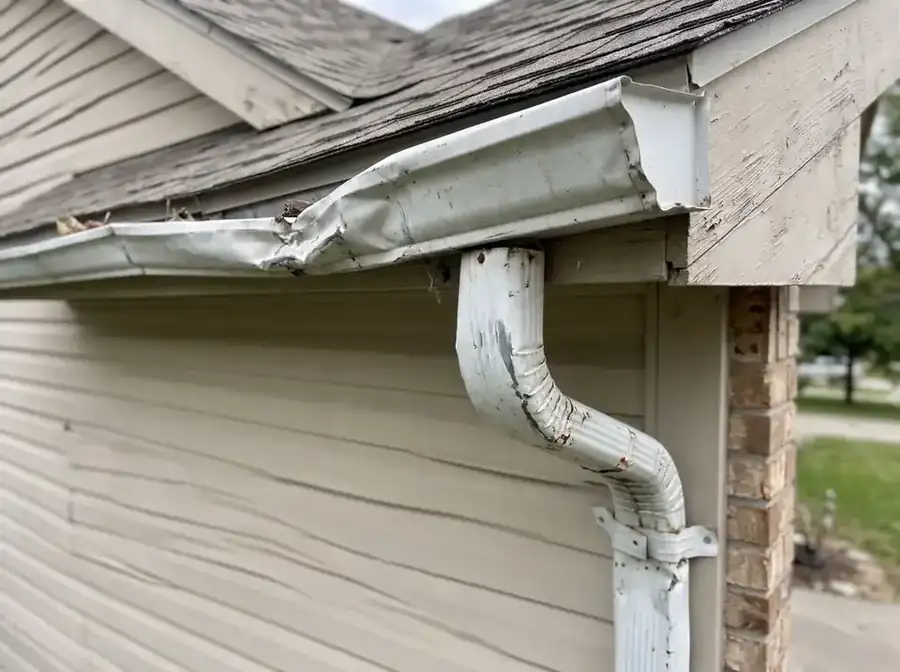
| Part | Typical damage | Why |
|---|---|---|
| Hangers and spikes | Pulled out | Ice weight on every foot |
| Gutter run | Rolled forward or dropped | Fixings fail |
| Corners and end caps | Seals cracked | Ice expands; run flexes |
| Downspouts | Seams split | Water freezes in a blocked pipe |
| Guards | Clip-in types dislodged | Ice and limbs |
| Fascia | Torn where fixings pulled | Wood already soft |
How should I respond after a storm?
- Assume any downed wire is live. Keep away and call the utility.
- Stay out from under ice-laden trees and eaves.
- Wait for the thaw before going near a ladder.
- Photograph every side of the house and each damaged item.
- Call your insurer before agreeing to repairs.
- Get the tree off and the roof secured first.
- Get written estimates from CCB-licensed contractors.
How do gutters fit into an insurance claim?
Gutters, downspouts and fascia are part of the dwelling. When a covered event such as a falling tree or the weight of ice damages them, the adjuster normally lists them by the foot alongside the roof. A gutter contractor can quote to that list. Upgrades beyond what was there are usually at your cost. Rust, rot and old blockages are maintenance, not storm damage.
Which specifications hold up better?
| Choice | Standard | Tougher option |
|---|---|---|
| Aluminum gauge | 0.027 inch | 0.032 inch |
| Metal | Aluminum | Painted steel, kept clean |
| Hangers | Spikes or clips at 3 feet | Hidden screw-in hangers at 2 feet or closer |
| Fascia | Whatever is there | Sound wood; rot replaced before hanging |
| Guards | Clip-in screens | Framed micro-mesh, screwed down |
| Downspouts | 2x3 | 3x4 with clean-outs |
None of this stops a falling fir. It decides whether gutters survive ice alone and the smaller limbs.
What should be done before winter?
- Clean the gutters in late November so there is nothing to freeze.
- Check every run drains.
- Replace spikes with screw-in hangers.
- Have an arborist assess trees and limbs over the roof.
- Empty leaf traps and test underground lines.
- Know where the main limbs are relative to the service drop.
What about wind without ice?
Windstorms are a regular part of winter here. Their main effect on gutters is debris: needles, cones and twigs stripped from conifers and dumped on the roof. Outlets block overnight. A check after each big blow, or guards that keep the load out, prevents the overflow that follows. Stronger gusts add limb strikes and can peel off gutters that are still on spikes.
What should I keep on hand for storm season?
- Your insurer's claims number and policy number.
- The utility's outage and downed-line number.
- A certified arborist's contact.
- Photographs of the house and gutters taken in good condition.
- A flashlight and a way to keep people away from the eaves.
Those photographs matter. They show an adjuster what the gutters looked like before the storm.
What about the days after the thaw?
Meltwater has to go somewhere. Check that downspouts are running and not split, that leaf traps are clear of ice-broken twigs, and that no gutter is tilting forward. Look up for broken limbs still caught in the trees before walking under them.
The bottom line
Ice is occasional and trees are permanent. Clean gutters, close hangers and tended trees are the preparation. See ice and snow damage and storm damage repair.