
On this page
What does a gutter installation include?
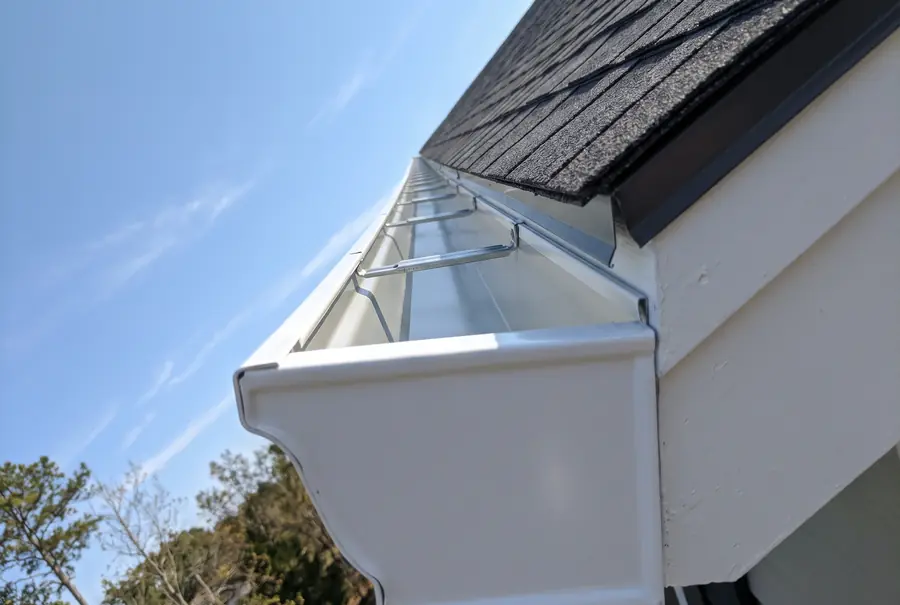
A gutter installation covers the whole route from roof edge to drain: the trough, the hangers that hold it, the outlets, the downspouts and the place each downspout empties. Beaverton Gutter Gurus connects callers with independent local gutter contractors, who give the estimates and do the work. A complete job normally includes:
- Measuring every eave and noting the roof area and valleys above it.
- Checking the wood. Fascia and rafter tails are probed for rot, which is common behind old gutters in a wet climate.
- Forming on site. A machine on the truck rolls seamless gutter from coil to the exact length.
- Hanging and pitching on hidden hangers, with a steady fall to each outlet.
- Downspouts, sized, strapped and connected to a drain line or extension. See downspouts.
- Sealing and testing corners, end caps and outlets.
- Removal of the old gutter.
How is a good installation done, step by step?
- Walk the roofline. The contractor looks at pitch, valleys, moss, overhanging firs and maples, and where the existing downspouts go.
- Trace the drains. Each underground line is checked with a hose to see that it runs.
- Repair the wood. Soft fascia is replaced and primed.
- Set the fall. A chalk line gives about a quarter inch of drop in every 10 feet.
- Form and hang. Gutter is rolled out, capped and lifted onto hidden screw-in hangers at 2-foot centers or closer.
- Join corners with rivets and sealant on the inside.
- Fit downspouts, with a clean-out or leaf trap above any underground connection.
- Test with water and clear up.
What are the parts of a gutter system?
| Part | What it does | What to ask for in Beaverton |
|---|---|---|
| Gutter (trough) | Catches water at the eave | Seamless aluminum, 0.032 inch on long runs |
| Hidden hanger | Fixes the gutter to the fascia | Screw-in type every 2 feet |
| End cap | Closes the end of a run | Crimped and sealed inside |
| Miter | Joins two runs at a corner | Riveted and sealed |
| Outlet (drop) | Lets water into the downspout | Wide-mouth; needles bridge small ones |
| Downspout | Carries water down | 3x4 inch below valleys |
| Clean-out or leaf trap | Stops debris entering a buried line | Above every underground connection |
| Drip edge or apron | Guides water into the gutter | Present, lapped over the gutter back |
| Guard | Keeps debris out | Micro-mesh under conifers |
What do Beaverton conditions mean for the design?
Months of use. Beaverton's climate table shows 39.05 inches of precipitation a year on 151 days, with December averaging 6.53 inches. A gutter here spends half the year wet. Pitch has to be right so water does not stand, and every joint has to be sealed on clean metal.
Needles and moss. Fir needles pack into outlets and moss washes off shaded roofs. Wide outlets, 3x4 downspouts and guards keep the system open. See moss, needles and gutters.
Ice and limbs. The storms of January 2024 brought down nearly 100 trees across Washington County. Close hanger spacing and heavier metal help a gutter carry ice and survive small branches. See ice storms, wind and gutters.
Clay and storm drains. Clean Water Services notes that Washington County has separate storm and sanitary systems and that rain runs quickly off its clay soils. Roof water should go to the storm system or to a spot where it can soak in without reaching the house.
Which profile and metal should I choose?
| Choice | Strengths | Limits | More |
|---|---|---|---|
| Aluminum K-style | Will not rust; many colors; lowest cost | Dents under ladders and limbs | Aluminum gutters |
| Aluminum fascia-style | Matches houses built without fascia boards | Fewer contractors carry the machine | Seamless gutters |
| Painted steel | Stiff; carries ice and ladders | Rusts where the coating fails | Metals compared |
| Copper half-round | Very long life; soldered joints | Highest cost; reacts with zinc moss treatments | Copper gutters |
| Half-round in aluminum | Suits older houses with rafter tails | Holds less than K-style | Half-round gutters |
What should a written gutter quote include?
- Total feet of gutter, with size and profile
- Metal, thickness and color
- Hanger type and spacing
- Number, size and position of downspouts
- How each downspout discharges, and any drain-line work
- Fascia or rafter-tail repairs, priced separately
- Guards, if included
- Removal and disposal of old gutter
- Warranty on materials and workmanship
- The contractor's business name and CCB number
What it costs
Published national guides put seamless aluminum at about $9 to $14 a foot installed in 5-inch and $11 to $17 in 6-inch, steel at $12 to $20 and copper at $29 to $40. Those are national ranges, not Beaverton quotes. Second-story eaves, hillside access, fascia repair, guards and drain work all move the number. The cost guide has sources and a worked example.
Ballpark for your roofline
$1,440 to $2,240
Arithmetic from national price ranges (Angi aluminum gutter cost guide, This Old House seamless gutter cost guide), not a local quote. The number of corners and downspouts, fascia repairs and awkward access all move it. A contractor who has measured your house gives the real figure.
Installation services
- Seamless gutters: formed on site, joints only at corners and ends
- 6-inch gutters: for valleys, big roofs and long runs
- Half-round gutters: for older and custom homes
- Copper gutters: soldered, long-lived
- Aluminum gutters: the standard choice
- Downspouts: sizing, placement and discharge