
On this page
- What makes a downspout layout work?
- What are the parts of a downspout?
- How do 2x3 and 3x4 compare?
- Where does the water go in Washington County?
- What are the discharge options?
- How do I keep underground lines clear?
- How are downspouts installed?
- What should I ask about downspouts?
- How many downspouts does a typical Beaverton house have?
- What affects the price
What makes a downspout layout work?
A downspout layout works when every part of the gutter has a short route to an outlet, every outlet can pass both water and debris, and every downspout empties into something that takes the water away. Beaverton Gutter Gurus connects callers with independent local gutter contractors, who give the estimates and do the work.
What are the parts of a downspout?
| Part | What it does |
|---|---|
| Outlet (drop) | Opening in the gutter floor |
| Upper elbows | Bring the pipe back to the wall |
| Downspout | The vertical pipe, 2x3 or 3x4 inch, or round |
| Straps | Fix the pipe to the wall |
| Leaf trap or clean-out | Catches debris and gives access above a buried line |
| Adapter | Joins the downspout to the underground pipe |
| Rain drain | The buried pipe to the street or storm system |
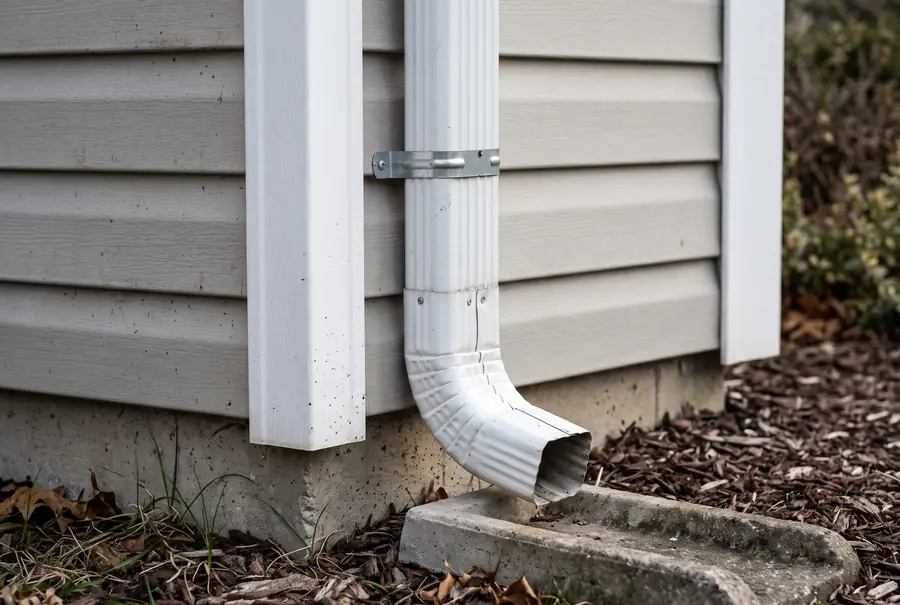
| Extension and splash block | Used where there is no buried line |
How do 2x3 and 3x4 compare?
| Feature | 2x3 inch | 3x4 inch |
|---|---|---|
| Cross-section | 6 square inches | 12 square inches |
| Paired with | 5-inch gutter | 6-inch gutter, or 5-inch at valleys |
| Fir needles | Bridge at elbows | Mostly pass |
| Appearance | Slimmer | More visible |
| Cost | Lower | A little higher |
Where does the water go in Washington County?
Clean Water Services, the county's water resources utility, describes two separately piped systems: sanitary sewers to the treatment plants, and stormwater pipes that lead from the outside of your home to storm drains and on to the Tualatin River. On many houses here, each downspout drops into a buried pipe that joins that storm system, often through an outlet in the curb.
The utility gives the reason plainly. Rain runs quickly off the hard clay soils here, and roof water that is not piped correctly can flood your property or your neighbor's.
What are the discharge options?
| Option | How it works | Suits | Watch for |
|---|---|---|---|
| Piped rain drain | Buried solid pipe to street or storm system | Most Beaverton houses | Blockage by needles and roots |
| Extension and splash block | Releases water on the surface | Lots that slope away; no buried line | Ponding on clay; neighbors |
| Rain garden | Planted basin that soaks water in | Level ground away from the house | Needs an overflow; not over septic |
| Rain barrel | Stores some water in summer | Garden watering | Reconnect the downspout for winter |
| Dry well or soakage trench | Infiltration underground | Soils that drain | Often unsuitable in clay |
Clean Water Services advises that a rain garden should not go over a septic system or where water already ponds, and OSU Extension suggests first learning how runoff from your roof is currently routed.
How do I keep underground lines clear?
- Fit a leaf trap or clean-out where each downspout enters the ground.
- Use guards or clean the gutters so needles do not reach the pipe.
- Flush each line with a hose once a year and confirm water reaches the curb.
- Watch for overflow at the top of the downspout in heavy rain.
- Have blocked lines cabled or jetted before the wet season.
How are downspouts installed?
- Place the outlets at low points and near valleys.
- Cut and fit each outlet, riveted and sealed.
- Build the offset with two elbows.
- Strap the pipe at top, bottom and between.
- Connect to the buried line through a clean-out, or fit an extension.
- Run water and confirm where it goes.
What should I ask about downspouts?
- How many, what size, and where?
- Will each one tie into an existing drain line, and has that line been tested?
- Will a clean-out or leaf trap be fitted?
- If a line is blocked, what will clearing it cost?
- Where does the water end up?
How many downspouts does a typical Beaverton house have?
A ranch commonly has four to six, a two-story house six to eight. Each should have somewhere tested to send its water. If two are close together and one drain line is blocked, a contractor may combine them, provided the remaining pipe can take both.
What affects the price
Downspouts are priced by length, size and elbows, with extra for second-story drops. Clean-outs and adapters are small items. Clearing or replacing an underground line is a larger job priced by length and by what has to be dug through. Ask for the drainage work to be itemized.