
On this page
- When should gutters be replaced?
- What does a gutter replacement involve?
- Why do old steel gutters fail here?
- What about fascia-style gutters?
- What should I upgrade while the gutters are off?
- Which material should replace the old one?
- What should I check on the day?
- How does replacement fit with a new roof?
- What should I ask before signing?
- What it costs
When should gutters be replaced?
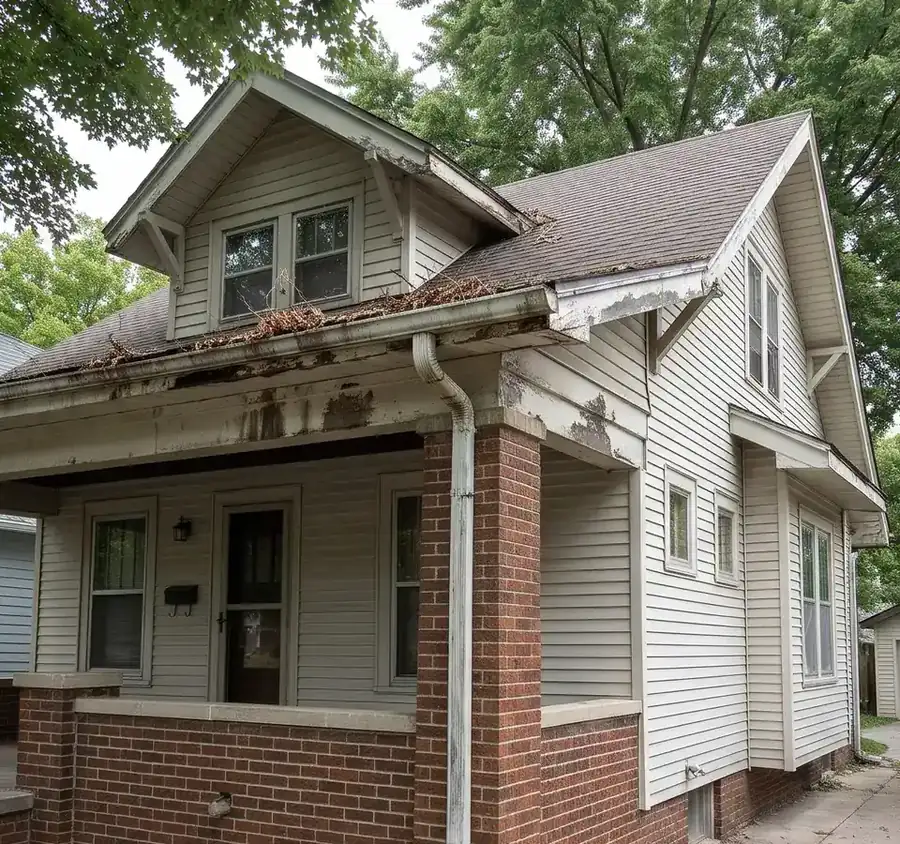
Gutters should be replaced when the faults run along the whole system instead of sitting at one joint. Beaverton Gutter Gurus connects callers with independent local gutter contractors, who give the estimates and do the work, and a contractor weighing repair against replacement looks for these signs:
| Sign | What it means | Repair or replace |
|---|---|---|
| Rust streaks or holes in the gutter floor | Steel coating has failed | Replace |
| Leaks at many seams | Sectional gutter at end of life | Replace with seamless |
| Sagging along several eaves | Fixings failing; fascia may be soft | Replace and repair wood |
| Standing water and moss in the trough | Pitch lost | Replace or fully re-hang |
| Overflow when clean | Too small or too few outlets | Replace or add downspouts |
| A single leaking corner | One joint | Repair |
What does a gutter replacement involve?
- Inspection and measurement of every eave and downspout.
- Drain check. Underground lines are tested before new downspouts are tied in.
- Removal of old gutter, spikes and downspouts.
- Wood repair. Soft fascia and rafter tails are replaced and primed.
- Drip edge added where the roof has none.
- New gutter formed on site, pitched and hung on hidden hangers.
- Downspouts fitted with clean-outs and connected.
- Test and haul away. Old metal goes for recycling.
Why do old steel gutters fail here?
Older Beaverton houses often still carry galvanized steel gutters. The city grew from 5,937 people in 1960 to 31,962 in 1980, so a great many houses date from those years. Steel is strong, but its zinc coating wears away where wet debris sits. With rain on 151 days a year, a gutter that is not cleaned holds damp needles against the metal for months. Rust starts on the floor of the trough and at the seams, and by the time it shows on the outside the metal is thin along its length.
What about fascia-style gutters?
On many Northwest houses the gutter is the fascia: a tall, flat-faced trough nailed straight to the rafter tails. When it fails there are two routes.
| Route | What is done | Suits |
|---|---|---|
| Like for like | New seamless fascia-style gutter formed to match | Houses where the look should not change |
| Convert | Fascia board added to the rafter tails; K-style gutter hung on it | Rafter tails need protecting; wider choice of contractors |
Either way the rafter tails are exposed during the work, so any rot in them can be dealt with.
What should I upgrade while the gutters are off?
| Upgrade | Why it helps in Beaverton | More |
|---|---|---|
| Aluminum in place of steel | No rust | Aluminum gutters |
| Seamless in place of sectional | Far fewer joints to leak | Seamless vs sectional |
| Hidden hangers at 2 feet | Carries wet debris and ice | Sagging gutters |
| 3x4 downspouts and wide outlets | Needles pass through | Downspouts |
| Clean-outs above drain lines | Keeps buried pipes clear | Downspout drainage |
| Micro-mesh guards | Stops fir needles | Gutter guards |
| Drip edge | Stops water running behind | Fascia and soffit |
Which material should replace the old one?
Most replacements are seamless aluminum. Steel is stiffer and still has a place under heavy tree cover where limbs and ice are a concern, if it will be kept clean. Copper suits older and custom homes. The guide to aluminum, steel and copper compares them.
What should I check on the day?
- The coil color against the trim before any gutter is formed.
- Soft wood found during removal, shown to you and priced before it is covered.
- Outlet positions, especially below valleys.
- A clean-out or leaf trap at every underground connection.
- A hose test on each run and each drain line before the crew leaves.
How does replacement fit with a new roof?
| Order | Step | Why |
|---|---|---|
| 1 | Old gutters removed | Clears the eave for the roofer |
| 2 | Roof and drip edge installed | Flashing laps correctly |
| 3 | Fascia repaired and painted | Wood is exposed and reachable |
| 4 | New gutters hung | Sits under the new drip edge |
| 5 | Guards fitted | Last, so nothing is disturbed |
If the roofer and the gutter contractor are different firms, agree who repairs the fascia before either starts.
What should I ask before signing?
- Is the new gutter aluminum, and what gauge?
- Will you match my fascia-style profile or convert to K-style?
- What is the per-foot price for wood repair?
- Will every drain line be tested?
- What is your CCB number?
What it costs
Published national guides put replacement at about $9 to $14 a foot for 5-inch seamless aluminum and $11 to $17 for 6-inch, installed. Removal, fascia repair, second-story eaves, hillside access and guards add to that. These are national ranges, not Beaverton quotes. See the cost guide.
Ballpark for your roofline
$1,440 to $2,240
Arithmetic from national price ranges (Angi aluminum gutter cost guide, This Old House seamless gutter cost guide), not a local quote. The number of corners and downspouts, fascia repairs and awkward access all move it. A contractor who has measured your house gives the real figure.