
On this page
- The short answer
- Why does it matter so much here?
- How much water comes out of one downspout?
- How is the storm system set up?
- What are the options?
- How do rain drains fail?
- What about hillside lots?
- What about moss treatments and downspouts?
- How do I check what I have?
- What mistakes are common?
- When should I get advice beyond a gutter contractor?
- The bottom line
The short answer
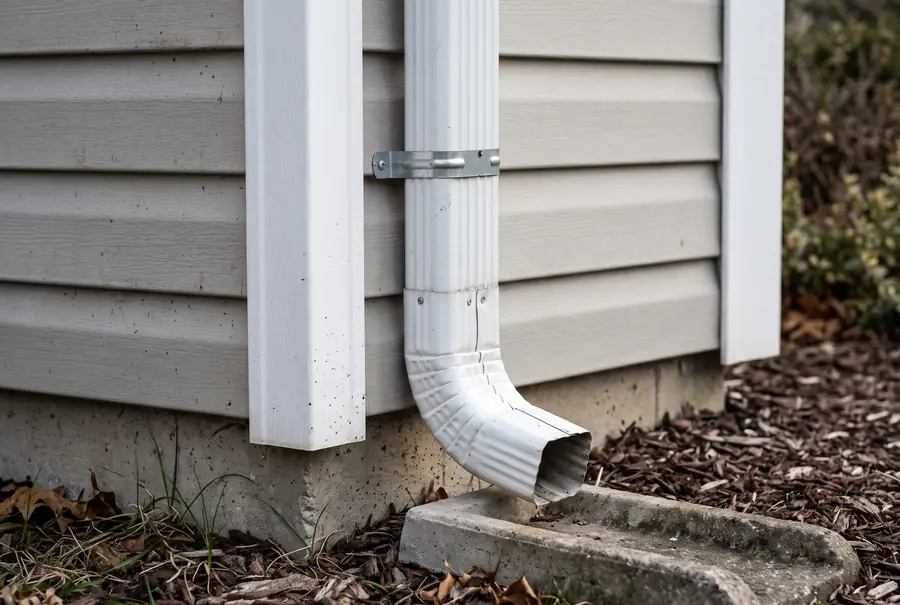
Every downspout should deliver its water to something that takes it away: usually the piped storm system, sometimes a rain garden or open ground that falls away from the house. On Washington County clay, water left at the wall stays there. Beaverton Gutter Gurus connects callers with independent local gutter contractors, who give the estimates and do the work.
Why does it matter so much here?
Two reasons: the soil and the season. Clean Water Services describes the local soils as hard clay that rain runs off quickly. And Beaverton's climate table shows precipitation on 151 days a year, so the ground beside a house with a failed downspout is wet from fall to spring. Many houses here sit over crawl spaces, and persistent water at the wall finds its way under.
How much water comes out of one downspout?
Using the Clean Water Services figure of about 625 gallons per inch of rain on 1,000 square feet of roof:
| Roof area on one downspout | Quarter-inch day | One-inch day | December average (6.53 in) |
|---|---|---|---|
| 300 sq ft | About 47 gallons | About 188 gallons | About 1,220 gallons |
| 500 sq ft | About 78 gallons | About 313 gallons | About 2,040 gallons |
| 800 sq ft | About 125 gallons | About 500 gallons | About 3,270 gallons |
Over a year, a 2,000 square foot roof in Beaverton sheds roughly 49,000 gallons.
How is the storm system set up?
Clean Water Services explains that Washington County has two separately piped systems. Sanitary sewers carry wastewater to treatment. Stormwater pipes lead from the outside of homes to storm drains and eventually the Tualatin River. Clean Water Services and its partner cities look after the public part. The pipe from your downspout to the street is private, and the utility's rainwater management page states that it does not maintain private drainage or step into lot-to-lot disputes.
What are the options?
| Option | Cost level | Upkeep | Best where |
|---|---|---|---|
| Piped rain drain to street or storm system | In place on many houses | Keep clear; flush yearly | Most lots |
| Extension and splash block | Low | Keep attached | Ground slopes away; no buried line |
| Rain garden | Medium | Weeding; check overflow | Level ground with room, away from the house |
| Rain barrel | Low | Reconnect downspout for winter | Summer watering |
| New buried line | Medium to high | As above | Old line crushed or missing |
OSU Extension advises anyone considering a rain garden to first learn how runoff from the roof is currently routed.
How do rain drains fail?
| Failure | Sign | Fix |
|---|---|---|
| Needles and silt | Water backs up the downspout | Flush or jet; fit leaf trap |
| Roots | Slow drain; recurring blockage | Cable; replace section |
| Crushed pipe | Sunken strip in lawn or drive | Dig and replace |
| Separated at the downspout | Water at the wall | Refit adapter |
| Blocked curb outlet | No flow at the street | Clear the outlet |
What about hillside lots?
On Cooper Mountain, Sexton Mountain, Bull Mountain and the West Hills, where roof water is released matters for the slope as well as the house. Water should not be discharged onto a steep bank or toward a downhill neighbor. Piped discharge to the street or an engineered outlet is the norm on these lots, and changes should be checked with the city or county.
What about moss treatments and downspouts?
Clean Water Services advises disconnecting roof drain downspouts when applying moss control products to a roof, so that treated runoff does not flow straight into the storm system and on to the streams. Reconnect them afterward.
How do I check what I have?
- Count the downspouts and note which go into the ground.
- Run a hose into each and look for flow at the curb.
- Look for water at the base in steady rain.
- Walk the line of each pipe for sunken or soggy ground.
- Check that extensions, where used, discharge onto ground that falls away.
- Look in the crawl space after a wet week.
What mistakes are common?
| Mistake | Result | Better |
|---|---|---|
| Downspout left out of its drain | Water at the foundation all winter | Refit the adapter |
| Corrugated flexible pipe underground | Silts up; crushes | Smooth-wall solid pipe |
| No clean-out | Line cannot be cleared without digging | Fit one at each downspout |
| Rain barrel left connected in winter | Overflows at the wall | Reconnect the downspout |
| Discharge onto a slope | Erosion; unhappy neighbor | Pipe to the street |
| Dry well in clay near the house | Water returns to the foundation | Use the storm system |
When should I get advice beyond a gutter contractor?
For water in a crawl space that persists after the gutters and drains are working, for drainage on a steep or unstable slope, and for any change that would send water toward a neighbor or a stream. Your city, Washington County or Clean Water Services can say what is allowed.
The bottom line
In Beaverton the storm system is where roof water belongs on most lots. Keep the gutters clear, fit clean-outs, test the buried lines each fall, and repair a separated downspout as soon as you see it. See downspouts and downspout repair.