
On this page
- Are gutter guards worth it in Beaverton?
- Which type of guard suits local trees?
- What falls on a Beaverton roof, and when?
- How does moss change the picture?
- How are gutter guards installed?
- When should I skip guards?
- What do guards cost to own over time?
- How do guards and underground drains work together?
- What should I ask a guard installer?
- What affects the price
- Guard pages
Are gutter guards worth it in Beaverton?
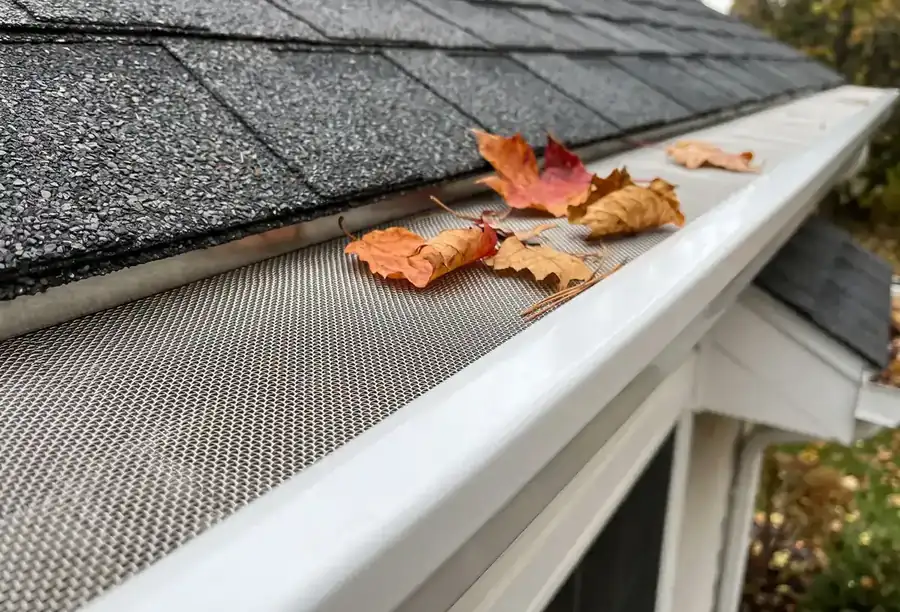
Gutter guards are covers that let water into the gutter and keep needles, leaves and moss out. In Beaverton they earn their cost on houses under conifers, where gutters would otherwise need clearing three or four times a year. Beaverton Gutter Gurus connects callers with independent local gutter contractors, who give the estimates and do the work, and a contractor will look at three things before recommending a guard:
- What falls on the roof. Needles demand a finer guard than leaves.
- Shade and moss. A north-facing run under trees needs a guard that can be brushed clean.
- The gutter itself. Size, pitch and hangers have to be right first.
Which type of guard suits local trees?
| Guard type | How it works | Douglas fir and cedar needles | Maple and alder leaves | Moss |
|---|---|---|---|---|
| Stainless micro-mesh | Fine woven mesh on a frame | Stopped | Stopped | Sits on top; brushes off |
| Perforated aluminum cover | Sheet with punched holes | Needles lodge in holes | Good | Clogs the holes |
| Reverse-curve cover | Water follows a curved nose | Needles follow the water in | Good | Grows on the nose |
| Plastic screen | Clip-in grid | Poor | Fair | Holds moss |
| Foam or brush insert | Fills the trough | Poor; traps needles | Poor | Becomes a moss bed |
Details are on the pages for micro-mesh gutter guards and screen and reverse-curve guards.
What falls on a Beaverton roof, and when?
| Season | Debris | Trees | Effect on gutters |
|---|---|---|---|
| Spring | Seed wings, catkins, pollen, cones | Bigleaf maple, alder, fir | Fine litter that mats when wet |
| Summer | Dry needles; little else | Douglas fir, cedar | Slow build-up in dry gutters |
| September to December | Leaves, heavy needle drop | Maple, oak, fir, cedar | The main fill, just as the rain starts |
| Winter storms | Needles, twigs, branches | All conifers | Sudden blockages after wind and ice |
| All wet months | Moss washed from the roof | Shaded roofs | Roots in gutter silt; holds water |
Unlike leaf trees, conifers never stop. That is why a house under firs can have full gutters in any month.
How does moss change the picture?
Moss needs shade and moisture, and Beaverton's tree-covered lots supply both. Oregon State University Extension says the most effective long-term step is trimming trees so sun reaches the roof. For guards, moss matters in two ways. Clumps slide off the roof and sit on the mesh, and a guard left covered in debris becomes a place for moss to grow. A guard that can be reached and brushed, set at a slope so debris sheds, copes best.
One caution: OSU advises against zinc sulfate moss treatments on roofs with copper gutters, because zinc corrodes copper.
How are gutter guards installed?
- Clean and flush gutters, downspouts and drain lines.
- Correct the gutter: hangers, pitch, leaks.
- Cut guard sections for each run and miter the corners.
- Fix the guard to the front lip and to the fascia or gutter back. Types that avoid lifting the shingles are kinder to an older or mossy roof.
- Treat valleys with diverters where water concentrates.
- Water-test each run.
When should I skip guards?
- No trees stand within reach of the roof.
- The gutters are rusted steel or sagging and need replacing first.
- The roof is due for replacement soon.
- The only affordable option is a coarse screen that needles will defeat. Regular gutter cleaning does more for the money.
The guide are gutter guards worth it? works through the sums.
What do guards cost to own over time?
Buying a guard is one cost. Owning it has more, and it helps to ask about each:
| Cost | Micro-mesh | Screen or perforated cover | No guard |
|---|---|---|---|
| Purchase and fitting | Highest | Low to medium | None |
| Routine upkeep | Brush-off once or twice a year | Regular clearing of lodged needles | Two to four cleanings a year |
| After a storm | Check; may need a panel replaced | Often needs refitting | Clean out the debris |
| At re-roofing | May be lifted and refitted | Usually replaced | Nothing to do |
Under conifers, the first column usually wins over ten years. With leaf trees only, the last one often does.
How do guards and underground drains work together?
A guard's quiet benefit in Washington County is what it keeps out of the buried pipe. Needles that never enter the gutter never reach the downspout, the leaf trap or the rain drain under the lawn. Since Clean Water Services leaves private drainage to the owner, keeping that pipe clear saves the cost of cabling or digging it up later.
What should I ask a guard installer?
- Which product, and what is the mesh made of?
- How is it fixed at the front and the back?
- How do you treat valleys?
- Is cleaning and tuning the gutter included?
- What does the warranty cover, and who honors it?
What affects the price
Guard prices depend on the type, the feet of gutter, the height of the eaves and how many corners and valleys need special treatment. Professionally fitted micro-mesh costs several times what a basic screen does. National price guides give broad ranges, and a contractor's written quote for your roofline is the figure to rely on. Ask whether cleaning and gutter repairs are included, and who backs the warranty.
Guard pages
- Micro-mesh gutter guards: the fine-mesh option for conifers
- Screen and reverse-curve guards: where the simpler types fit