
On this page
- What types of guard are there besides micro-mesh?
- How does each cope with local debris and weather?
- Perforated aluminum covers
- Screens
- Reverse-curve hoods
- Foam and brush inserts
- How do they stand up to storms?
- How do I choose?
- What goes wrong, and how do I spot it?
- Can an existing guard be kept?
- Is there any case for the cheaper guards here?
- What affects the price
What types of guard are there besides micro-mesh?
Besides micro-mesh there are four families of gutter guard: perforated metal covers, wire or plastic screens, reverse-curve hoods, and inserts of foam or brush. Beaverton Gutter Gurus connects callers with independent local gutter contractors, who give the estimates and do the work.
How does each cope with local debris and weather?
| Type | Fir needles | Maple leaves | Moss | Steady rain | Relative cost |
|---|---|---|---|---|---|
| Perforated aluminum cover | Poor to fair | Good | Clogs holes | Good | Low to medium |
| Wire or expanded screen | Poor | Good | Tangles | Good | Low |
| Plastic snap-in screen | Poor | Fair | Holds it | Good | Lowest |
| Reverse-curve hood | Poor to fair | Good | Grows on nose | Good | High |
| Foam insert | Poor | Fair | Becomes a moss bed | Slows flow | Low |
| Brush insert | Poor; traps needles | Fair | Holds it | Good | Low |
Perforated aluminum covers
A flat or ribbed aluminum sheet with small punched holes, screwed to the front lip. It is sturdy and sheds broad leaves well. Needles are the problem: they stand upright in the holes or slip through. It suits houses under maples, oaks or alders with no conifers nearby.
Screens
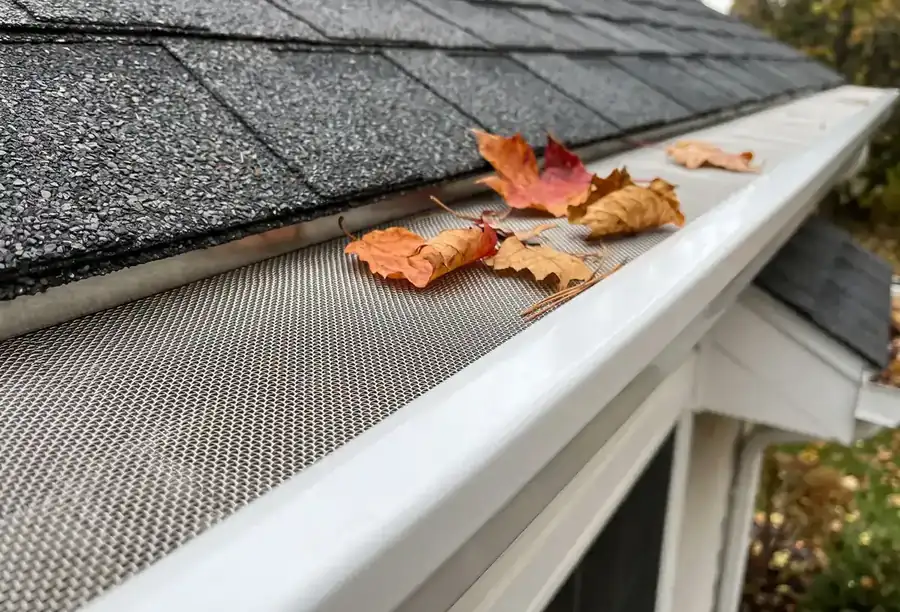
Wire mesh, expanded metal or plastic grids that drop into or clip onto the gutter. They are cheap and quick to fit. They lift in wind unless fastened, sag under wet leaves and let needles through. A screwed-down metal screen is a fair budget answer on a one-story run under a single leaf tree.
Reverse-curve hoods
A solid cover with a curved front edge. Water follows the curve into a slot; leaves slide off. Points to weigh here:
- Needles ride the water round the curve and into the gutter.
- Moss and algae grow on the nose in shade and break the water's grip, so it drips past.
- Cleaning means removing the hood.
- Looks. The hood shows from the ground.
- Cost. Branded systems are priced near micro-mesh.
Foam and brush inserts
Foam wedges and bottle-brush inserts sit inside the gutter. In a climate that keeps them wet for five months they fill with needles and silt and grow moss and seedlings. Both have to be lifted out to clean. They are seldom recommended in the Northwest.
How do they stand up to storms?
Clip-in guards can lift in winter windstorms, and brittle plastic can break under ice or a fallen branch. After an event like January 2024, guards need checking along with the gutters. A framed stainless micro-mesh guard, screwed down, is the sturdier choice.
How do I choose?
- Name your trees. Any fir, cedar or pine overhead points to micro-mesh.
- Look at the shade. Damp north sides rule out foam and plastic.
- Count the stories. The harder cleaning is, the more a better guard is worth.
- Check the gutters. Guards go on sound, pitched gutters only.
- Check HOA rules on visible hoods.
- Compare lifetime cost against cleaning.
What goes wrong, and how do I spot it?
| Guard | Common failure here | Sign |
|---|---|---|
| Perforated cover | Holes plugged with needles | Water runs over the front |
| Wire screen | Sagged into the gutter | Leaves sitting in a trough on top |
| Plastic screen | Green with moss; cracked | Plants growing through |
| Reverse-curve | Algae on the nose | Drip line on the ground below |
| Foam | Saturated; seedlings rooted | Overflow along the whole run |
Can an existing guard be kept?
- Have a section lifted to see what is in the gutter beneath.
- If the trough is clean and the guard intact, keep it and brush the top.
- If needles have got through, the guard is the wrong type for your trees.
- If the gutter is being replaced, do not refit an old coarse guard on new gutter.
Is there any case for the cheaper guards here?
Yes: a one-story house with only maples, oaks or alders nearby, where a screwed-down perforated cover will shed the fall leaves and can be brushed from a short ladder. Once a fir or cedar stands within reach of the roof, the case is gone.
What affects the price
Screens and perforated covers cost a fraction of micro-mesh or branded reverse-curve systems. The total depends on feet of gutter, height and corners. With any guard, ask what happens when it clogs: who cleans it, and at whose cost.
Ballpark for your roofline
$1,440 to $2,240
Arithmetic from national price ranges (Angi aluminum gutter cost guide, This Old House seamless gutter cost guide), not a local quote. The number of corners and downspouts, fascia repairs and awkward access all move it. A contractor who has measured your house gives the real figure.