
On this page
- Why do gutters sag?
- What are the types of gutter hanger?
- How is a sagging gutter re-hung?
- What pitch should a gutter have?
- How do I tell a sag from a bigger problem?
- What did January 2024 show?
- How can I stop it happening again?
- What does a re-hang visit look like?
- How much weight is a gutter carrying?
- Will a re-hung gutter hold through the next ice storm?
- What affects the price
Why do gutters sag?
Gutters sag when their fixings loosen, when the wood behind them fails, or when they carry more weight than they were hung for. Beaverton Gutter Gurus connects callers with independent local gutter contractors, who give the estimates and do the work. The usual causes here:
- Wet debris. Needles and moss hold water like a sponge for months.
- Spikes backing out of softened wood.
- Hangers too far apart.
- Rotten fascia or rafter tails.
- Ice during a freezing-rain event.
- Limbs and ladders.
What are the types of gutter hanger?
| Hanger | How it fixes | Strength | Notes |
|---|---|---|---|
| Spike and ferrule | Long nail through the gutter | Weakest over time | Common on older houses |
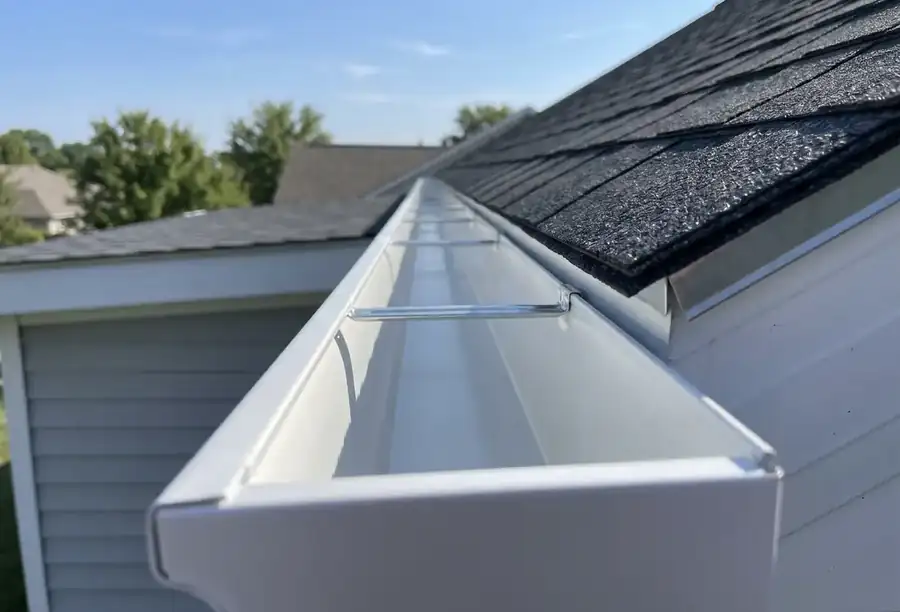
| Hidden hanger with screw | Clips inside; screws to fascia | Strong | Current standard |
| Fascia-gutter nails or screws | Through the back into rafter tails | Depends on the wood | Fascia-style gutter |
| Strap hanger | Strap fixed to the roof deck | Strong | No fascia needed |
| Bracket | Under the gutter | Strong | Half-round |
How is a sagging gutter re-hung?
- Empty the gutter and check it for creases and rust.
- Probe the fascia and rafter tails along the run.
- Snap a new pitch line.
- Release the old fixings and lift the gutter to the line.
- Fit hidden screw-in hangers every 2 feet, closer near corners.
- Pull old spikes and seal the holes.
- Reseal corners disturbed by the movement.
- Run water and confirm it drains fully.
What pitch should a gutter have?
| Run length | Usual arrangement |
|---|---|
| Up to about 30 feet | Fall one way to a single outlet |
| 30 to 40 feet and more | High point in the middle; outlet at each end |
| Valley partway along | Outlet near the valley |
| Fascia-style gutter | Fall built in when hung; shims at rafter tails |
How do I tell a sag from a bigger problem?
| What you see | What it means |
|---|---|
| Dip between two fixings | Hanger problem |
| Whole run tilted forward | Fascia rotating or rotten |
| Crease or kink | Metal damaged; replace that section |
| Gap between roof edge and gutter | Water runs behind |
| Moss and plants growing in the trough | Long-standing ponding |
What did January 2024 show?
Washington County's emergency declaration recorded nearly 100 fallen trees and power cuts to tens of thousands of households, and forecasters warned of up to an inch of ice in the days that followed. Ice on a gutter is dead weight on every hanger, and it arrives when the gutter may already be full. See ice and snow damage.
How can I stop it happening again?
- Keep gutters clean so they never carry months of wet debris. See gutter cleaning.
- Replace spikes with screw-in hangers before they fail.
- Ask for 0.032-inch aluminum and 2-foot spacing on new runs.
- Fit guards under conifers.
- Use ladder standoffs.
What does a re-hang visit look like?
A contractor normally re-hangs one elevation at a time. The run is emptied of needles, moss and water, the old spikes or clips are released, and the gutter is propped while a chalk line is snapped. New hangers go in from the high end. Corners are resealed last, because lifting a run flexes its joints, and sealing waits for dry metal. The crew should show you any soft wood before fixing to it.
| After a re-hang | What it means |
|---|---|
| Water still stands mid-run | Pitch needs another adjustment |
| Drip at a corner that was dry before | Joint flexed; needs resealing |
| Hanger screw spins | Wood is soft at that point |
| Gutter sits below the drip edge with a gap | Needs an apron flashing |
How much weight is a gutter carrying?
A foot of 5-inch K-style gutter filled to the brim holds roughly a gallon of water, a little over 8 pounds. A 30-foot run that cannot drain is therefore holding around 250 pounds before any debris is counted, and saturated needles and moss are heavier than they look. Hidden hangers at 2 feet give that load fifteen fixing points instead of the eight or ten that old spike spacing provided.
Will a re-hung gutter hold through the next ice storm?
If the wood is sound and the hangers are screwed in at 2 feet or closer, it stands a far better chance than it did on spikes. Keeping it clean matters as much, since an empty gutter has little to freeze.
What affects the price
Re-hanging is priced by the length of run, height, slope and the number of hangers. Replacing fascia adds carpentry and paint. If the gutter is creased or rusted, a new seamless length is added at the per-foot rate.