
On this page
- Where do gutters leak?
- Why do joints fail here?
- How is a leaking joint properly repaired?
- Which repair suits which leak?
- Which sealant should be used?
- When is a leak a sign of something bigger?
- Can I fix a leak myself?
- When in the year should joints be resealed?
- What should I tell the contractor about a leak?
- What affects the price
Where do gutters leak?
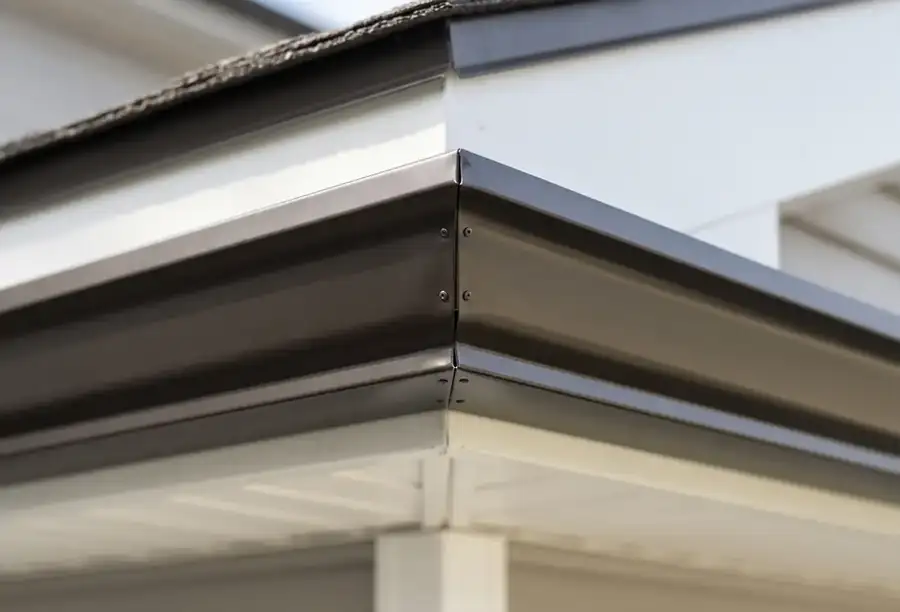
Gutters leak at their joints, and steel gutters also leak where rust has eaten through. Beaverton Gutter Gurus connects callers with independent local gutter contractors, who give the estimates and do the work.
| Leak point | What you see | Cause |
|---|---|---|
| Corner | Drip or stream below the corner | Sealant failed; rivets loose |
| End cap | Drip at the end of a run | Crimp opened |
| Outlet | Water down the outside of the downspout | Flange seal failed |
| Sectional seam | Drips at regular intervals | Connector seal aged |
| Gutter floor | Drips mid-run; rust stains | Steel rusted through |
| Behind the gutter | Stained fascia; drips from soffit | No drip edge; moss at the shingle edge |
Why do joints fail here?
- Time under water. With 151 wet days a year, a joint is submerged or damp for most of the winter.
- Debris. Needles and silt sit in corners, hold moisture against the seal and add weight.
- Standing water. A run without enough fall never drains, so its end cap and corner are always wet.
- Moss. It roots in the silt at a joint and wedges into any gap.
- Movement. Loose hangers let the run flex, which cracks the bead.
How is a leaking joint properly repaired?
- Run water to find the true source.
- Clear debris and moss from the joint.
- Scrape and wire-brush to bright metal.
- Dry the joint completely.
- Tighten it: re-rivet a loose miter or end cap.
- Apply gutter sealant in a continuous bead on the inside.
- Let it cure, then test.
- Correct the pitch if the run was holding water.
Which repair suits which leak?
| Leak | Repair | Lasting when |
|---|---|---|
| Corner | Strip, re-rivet, reseal | Miter is tight; run drains |
| End cap | Re-crimp or replace, seal | No standing water |
| Outlet | New outlet, riveted and sealed | At the true low point |
| Sectional seams | Reseal each, or replace the run | Few seams; otherwise go seamless |
| Rust hole | Patch in matching metal, sealed | Short term only |
| Behind the gutter | Fit drip edge; deal with moss | Gutter back sits under the flashing |
Which sealant should be used?
| Product | Use on gutters? | Note |
|---|---|---|
| Gutter and flashing sealant | Yes | Stays flexible; bonds to aluminum |
| Polyurethane sealant | Yes | Durable; needs clean, dry metal |
| Silicone caulk | Poor | Peels from metal |
| Roofing tar | No | Cracks; makes later repairs harder |
| Solder | Copper and steel only | The permanent joint for those metals |
When is a leak a sign of something bigger?
- Several joints leak at once. The sealant is worn out throughout.
- Rust shows along the gutter floor. The steel is finished. See gutter replacement.
- The same joint keeps failing. The run is moving or ponding.
- The fascia is soft. Water has been getting behind for years. See fascia and soffit.
- The gutter is sectional. Seamless replacement removes most joints.
Can I fix a leak myself?
On a one-story eave in a dry spell, a careful owner can reseal a corner by following the steps above. The dry spell is the hard part between October and May. On two-story houses, sloping lots or mossy roofs, the ladder work is the risk.
When in the year should joints be resealed?
Dry weather decides it. Portland's normals show July averaging about half an inch of rain against nearly six inches in December. Sealant bonds best to warm, dry metal, so the sensible time to reseal every corner on the house is late summer, before the rain returns. A leak found in winter can be given a temporary repair and done properly in the dry.
| Season | What can be done |
|---|---|
| July to September | Full strip and reseal of all joints |
| October to May | Temporary seal in a dry break; re-hanging; section replacement |
| Any time | Clearing debris and moss so joints are not sitting in water |
What should I tell the contractor about a leak?
Say which corner or run, how high it is, whether it drips in light rain or only heavy rain, what the gutter is made of, and whether water also shows behind the gutter or on the fascia. A photograph taken while it is dripping is the most useful thing you can send.
What affects the price
A single corner on a one-story run is a small job. The price rises with height, slope, the number of joints and whether a run has to be re-hung or replaced. Most contractors have a minimum visit charge, so have every joint checked and a cleaning done in the same visit.